
|
|
|
|
|
|
|---|---|---|---|---|---|
If everything seems under control, you're just not going fast enough. -- Mario Andretti
I will always be puzzled by the human predilection for piloting vehicles at unsafe velocities -- Data
 |
 |
 |
|---|---|---|
Car minimum mass           =  702 kg        Includes the driver and not the fuel
Engine volume              =  1.6 litres    Turbocharged. 2 energy recovery systems allowed
Energy recovery max power  =  120 kWatts
Energy recovery max energy =  2 Megajoules/lap
Engine typical power       =  670 kWatts  =  900 horsepower
Engine cylinders           =  6
Engine max frequency       =  15000 RPM
Engine intake              =  450 litres/second
Fuel consumption           =  .75 litres/km
Fuel maximum               =  150 litres
Forward gears              =  8
Reverse gears              =  1
Gear shift time            =  .05 seconds
Lateral accelertion        =  6 g's
Formula1 1g downforce speed=  128 km/h       Speed for which the downforce is 1 g
Formula1 2g downforce speed=  190 km/h       Speed for which the downforce is 2 g
Indycar 1g downforce speed =  190 km/h
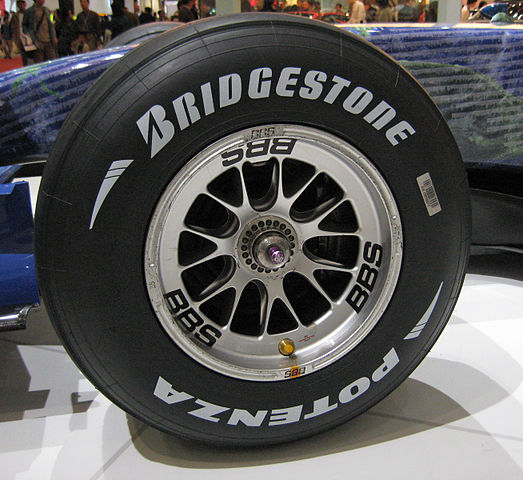
Rear tire max width        =  380 mm
Front tire max width       =  245 mm
Tire life                  =  300 km
Brake max temperature      = 1000 Celsius
Deceleration from 100 to 0 kph = 15 meters
Deceleration from 200 to 0 kph = 65 meters    (2.9 seconds)
Time to 100 kph            = 2.4 seconds
Time to 200 kph            = 4.4 seconds
Time to 300 kph            = 8.4 seconds
Max forward acceleration   = 1.45 g
Max breaking acceleration  = 6 g
Max lateral acceleration   = 6 g
Drag at 250 kph            = 1 g
 |
|---|
1950  Formula-1 begins. Safety precautions were nonexistent and death was considered
      an acceptable risk for winning races.
1958  Constructor's championship established
1958  First race won by a rear-engine car. Within 2 years all cars had rear engines.
1966  Aerodynamic features are required to be immobile (no air brakes).
1977  First turbocharged car.
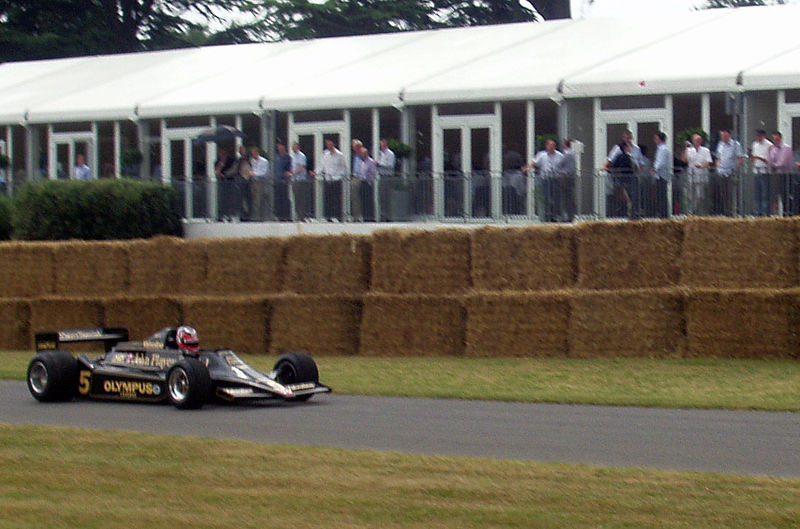
1978  The Lotus 79 is introduced, which used ground effect to accelerate air
      under the body of the car, generating downforce. It was also the first
      instance of computer-aided design. It was unbeatable until the introduction
      of the Brabham Fancar.
1978  The Brabham "Fancar" is introduced, which used a fan to extract air from
      underneath the car and enhance downforce. It won the race decisively.
      The rules committee judged it legal for the rest of the season but the
      team diplomatically
      Wiki
1982  Active suspension introduced.
1983  Ground effect banned. The car underside must be flat.
1983  Cars with more than 4 wheels banned.
1989  Turbochargers banned.
1993  Continuously variable transmission banned before it ever appears.
1994  Electronic performance-enhancing technology banned, such as active suspension,
      traction control, launch control, anti-lock breaking, and 4-wheel steering.
      (4-wheel steering was never implemented)
1999  Flexible wings banned.
2001  Traction control allowed because it was unpoliceable.
2001  Beryllium alloys in chassis or engines banned.
2002  Team orders banned after Rubens Barrichello hands victory to Michael
      Schumacher at final corner of the Austrian Grand Prix.
2004  Automatic transmission banned.
2007  Tuned mass damper system banned.
2008  Traction control banned. All teams must use a standard electrontrol unit.
2009  Kinetic energy recovery systems allowed.
 |
 |
 |
|---|---|---|
Place   Points          Place   Points

  1       25              6       8
  2       18              7       6
  3       15              8       4
  4       12              9       2
  5       10             10       1
 |
|---|